- How To Trace Dependents Excel
- Excel 2013 Trace Precedents On Another Sheet Online
- Excel 2013 Trace Precedents On Another Sheet Free
- Excel 2013 Trace Precedents On Another Sheet
Tracing Dependent and Precedent Cells
Excel 2013 includes a set of formula auditing tools in the Formula Auditing group of the FORMULAS ribbon. These tools allow users to see the relationships between formulas and cells.
The Trace Precedents and Trace Dependents options use arrows to show how an individual cell links to other cells, or is linked to from other cells. Things are relatively straightforward when all the related cells are on the same worksheet. Excel will draw arrows from the active cell to the related cell or cells. Use Trace Precedents Choose a formula and click Trace Precedents. It is on the Formulas ribbon in Excel 2007 and the Tools - Formula Auditing menu in Excel 97-2003. Excel will draw blue arrows to show all the cells that flow into this cell. The icon in the lower left means there were some off-sheet precedents. On the Formulas tab of the Ribbon, Excel has some tools to show these relationships with arrows. With C11 selected, the Trace Precedents button shows that C8, C9, and C11 all contribute directly to the result. Use remove arrows to clear arrows off the screen. Dependents are formula cells that depend on other cells.
Within the formula auditing section are the following tools:
On the Ribbon, click the Formulas tab, then click Trace Precedents; To see the next level of precedents, click the Trace Precedents command again; Blue arrows will show the path to the precendent cells. If a precedent is on a different sheet, a worksheet icon will appear at the beginning of the arrow. Click the “Trace Precedents” tool option and wait for a black arrow to appear indicating the precedent cell is in another worksheet. If the arrow is blue, indicating no errors with the.
Trace Precedents and Trace Dependents
The Trace Precedents and Trace Dependents options use arrows to show how an individual cell links to other cells, or is linked to from other cells.
Jolly card tab austria mame. Things are relatively straightforward when all the related cells are on the same worksheet. Excel will draw arrows from the active cell to the related cell or cells. However, even on the same sheet, there are a couple of capabilities that might not be immediately obvious.
The first time you click the ‘Trace’ button the cells that link directly to/from the active cell will be ‘arrowed’. Here we have selected cell H9 and clicked the Trace Precedents button:
We can see that H9 includes a reference to the range of cells B4:B8
If we click on the button again, cells that link directly to the first set of precedent cells will gain arrows and so on through to the cells that link directly and indirectly to the active cell.
The arrows themselves can be double-clicked – this will toggle the selection between the cells at either end of the arrow. The arrows can be removed using the Remove Arrows button in the Formula Auditing group.
If a cell links to another sheet then, instead of pointing at an actual cell, the Trace Precedents and Trace Dependents arrows will be dotted and point to a small picture of a worksheet. To see the details of the cells that relate to the selected cell, double-click the arrow itself (not the worksheet icon). This will display the Go To dialog with the related cells listed. Double-clicking on one of the cells listed in the Go To list will select that cell:
Display formulae
Switching from the display of cell values to cell formulae can help reveal inconsistent use of formulae or formulae that have been overwritten. You can switch to the display of formulae using FORMULAS ribbon tab > Formula Auditing group > Show Formulas:
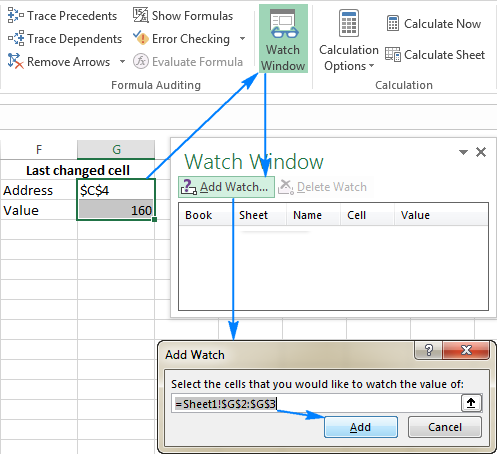
Watch Window
The FORMULAS ribbon tab >Formula Auditing group, also includes the Watch Window option.
This lets you add cells from anywhere in the current workbook and displays their current values. The Watch Window is within Excel the application, so if you have multiple workbooks open you can switch workbooks and add cells from other workbooks to the Watch Window. You can’t switch to a different workbook from within the Add Watch window.
The window displays the ‘live’ value of all the cells, from whichever open workbook, that have been added to the window. As well as displaying cell values, the Watch Window also allows you to navigate to any of the watched cells just by double-clicking them:
How To Trace Dependents Excel
Formula evaluator
Sometimes a formula might not give the result that you expect. If the formula is complex, maybe containing several functions, then it can be difficult working out just where the formula is going wrong. The FORMULAS ribbon tab > Formula Auditing section, includes the Evaluate Formula option. This evaluates each element of a formula individually:
Excel 2013 Trace Precedents On Another Sheet Online
Error Checker
Excel 2013 Trace Precedents On Another Sheet Free
Excel has a set of built-in rules to identify cells that might need attention. Some of the rules are obvious such as ‘Cells containing formulas that result in an error’ while others depend on slightly more subtle circumstances. The Error Checking settings and status of the individual rules can be accessed through FILE > Options > Formulas > Error Checking and Error checking rules sections:
The information icons next to each rule provide details of what the rule checks.
By default, cells that ‘contravene’ the rules are marked with a green indicator. Clicking on such a cell displays a warning icon which, when clicked, explains what the problem is and provides a series of possible resolutions.
Excel 2013 Trace Precedents On Another Sheet
If you are signed up to Skillsology check out our Excel course for more information on this: Section 5, Unit 7, Module 1 – Tracing Calculations.